
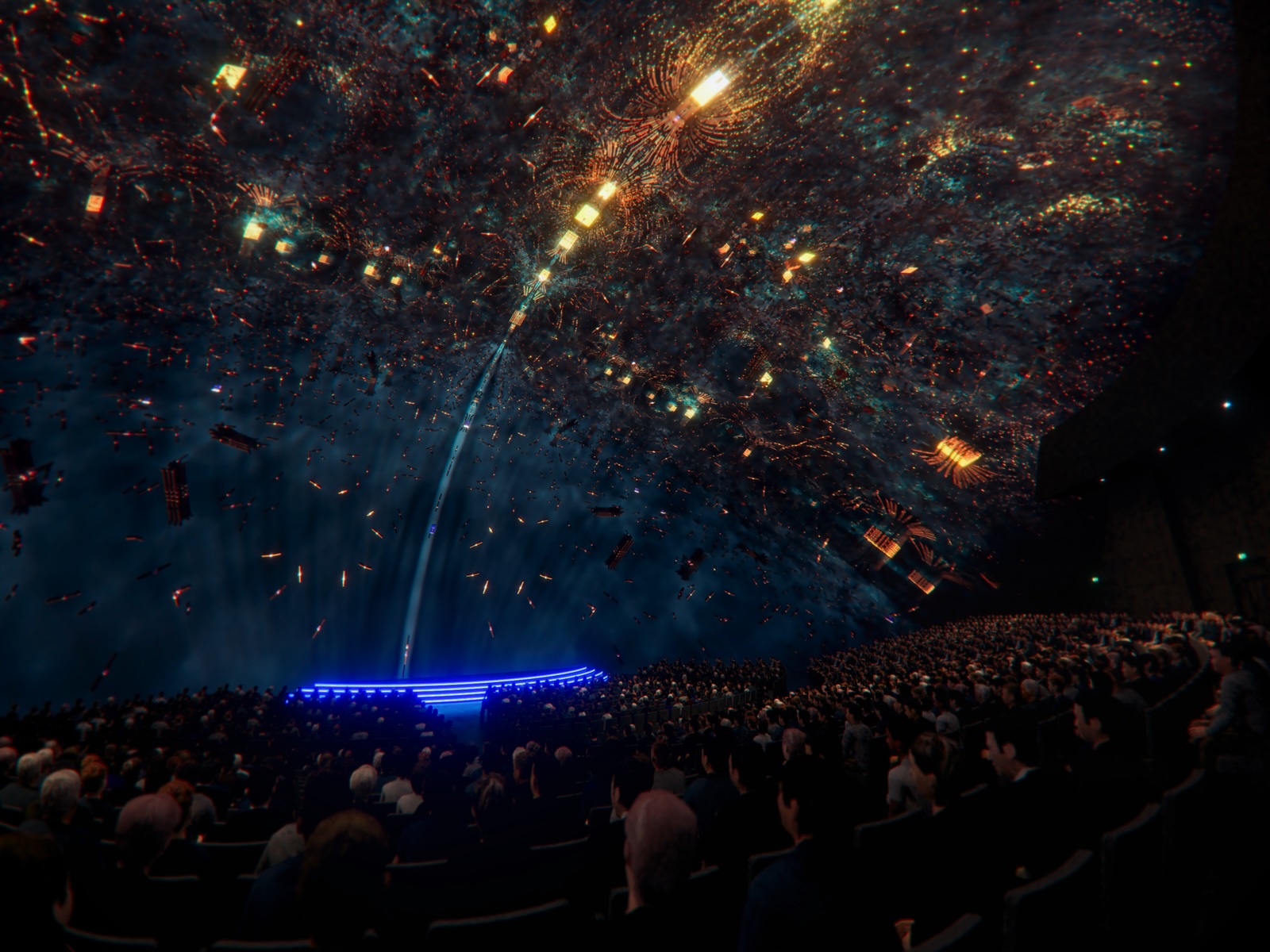
Julius Horsthuis’s 3D dome movie Recombination was by far the most popular movie on Theater last year. Why? Well, it's gorgeous.
A former visual effects artist, he left the world of traditional compositing to explore the infinite mathematical landscapes of fractals. His work feels simultaneously fantastical and familiar, transforming “simple” formulas into complex worlds.
As we release three more short films from the Amsterdam-based Horsthuis, we asked him how he makes his magic.
What made you leave traditional VFX for fractals?
I’ve always loved the technical aspects of filmmaking and enjoyed working in VFX. But I never had the ambition to keep doing that for the rest of my life. All the film jobs that I held, I used specifically to learn a lot of things about film that I thought were just invaluable. I think I was always looking for an excuse to quit VFX work, and when I found fractals and felt like I could make a living as an artist, I took the opportunity to focus on that full-time.
You mentioned you don’t position a camera when you’re producing your movies. How do you translate your cinematic language in your generative art?
I do position the camera—it's just that there's no screenshot that would communicate that. Most 3D software treats the camera as an object—one that you can look at or manipulate. In Mandelbulb3D, it works much more as how a first-person computer game does. You are the camera in the sense that you're always looking through it when navigating the fractal. The navigation works much like a game as well—the WASD buttons control the motion, together with the mouse for looking around. Actually I think this is a really intuitive, immersive way of creating fly-through animations. It does require some positional awareness.
So every one of your movies is a memento of a journey you have taken.
That's a nice way of putting it : )
People compare your work to psychedelics constantly. Does that annoy you or is it accurate?
To be honest it sometimes slightly annoys me when people immediately jump to the comparison with psychedelics, although I also understand it and think it’s probably accurate. Since I’m not a psychonaut myself, and don’t associate drugs with art, I can say the comparison is coincidental. Psychedelics might unlock imagination for some people, or have people look at the world or their own mind differently, but I don’t think it’s a prerequisite. Of course, none of this is a coincidence—fractals are ubiquitous and the mind must work at least partially fractally, so seeing these things in dreams or on psychedelics seems logical.
Is there a fractal formula you keep coming back to, like a favorite instrument?
For sure there are a few favorite formulas. I don’t think I can name a single one, but “Amazing Box” is a formula that keeps surprising me and is always very pleasurable to insert into a scene.
What's the longest render you've ever waited for?
Many people think rendering means waiting, and this isn’t always true. I don’t wait for renders—renders happen in the background on different computers than the one I’m working on. Renders flow in constantly, which means I can work on the color correction and other compositing tricks while the next scene is rendering. So render times are hard to measure since it’s a constant flow of a variety of shots, scenes, and layers. But if I had to give an answer, I’d say that for a single shot I may have waited a month. For an entire fulldome film that can add up to many months of rendering, but it’s never just “waiting”.
What looks bad in fractals? What are the clichés you avoid?
Good question! I think the most important thing to avoid is bad camera movement. The interface lets you put keyframes wherever you want, but doing this without careful thought or experience will make it look janky or amateurish. Trying to treat the camera as a real, heavy, real-world object with mass and momentum goes a very long way, even if it’s not always easy to do. Another thing is contrast. It’s easy to get a washed-out image without much light and dark places. One trick is to look at your render as a very small thumbnail. Does it look bland like that? Then the render is probably very CG-looking, even if zoomed-in it might look good.
Why do you think Recombination is so popular?
Recombination sits in that rare place where you have a musical, abstract audiovisual experience where the visuals are rich and balanced, complement the music, and most importantly show an aesthetic that’s not often seen. Pairing this with top quality immersion, you just have something that feels unique. It’s not for everyone, especially because it lacks a narrative. But for the people who would like to have their visual cortexes stimulated like music stimulates the auditive parts of the brain, I think this is special.
How do you find a “location” in infinite mathematical space?
This is the fun part! It’s the result of over a decade of exploration of the fractal worlds. I’ve just done a lot of moving and flying through the fractal structures, and each time I find something interesting, I create a snapshot that I can come back to. I have hundreds of these snapshots that very much read like the library of a location scout. Want a cool fractal forest? Visit this formula. Looking for an alien temple? This one got you covered.
Do you feel more like you're building these worlds or discovering them?
It’s very much exploration and uncovering. Not creating as much. I see my job as a fractal artist very much like a documentary maker. A lot of creative decisions about pacing, framing, choosing of locations, and deciding what makes the cut and what doesn’t. But I couldn’t claim to have made the fractals. They exist in a mathematical reality, and all I do is unearth them and show them to the audience.
See his movies: the sublime Cosmos, Recombination, Wave Function, Awe of Algebra and Geometric Properties are all available in Theater on Apple Vision Pro.
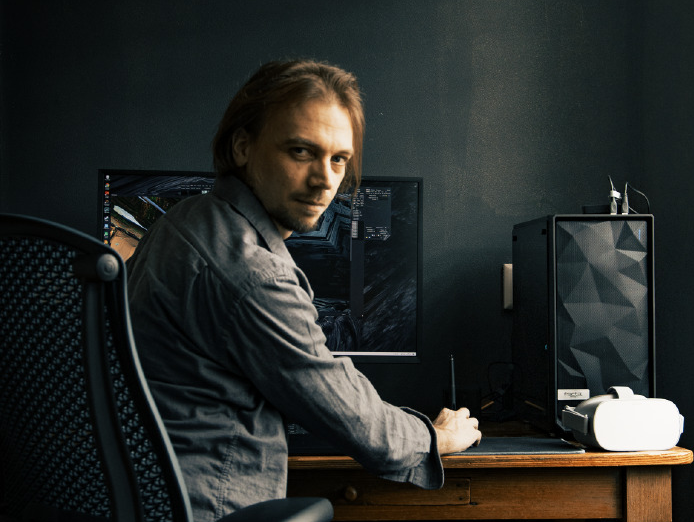
Julius Horsthuis in his studio.
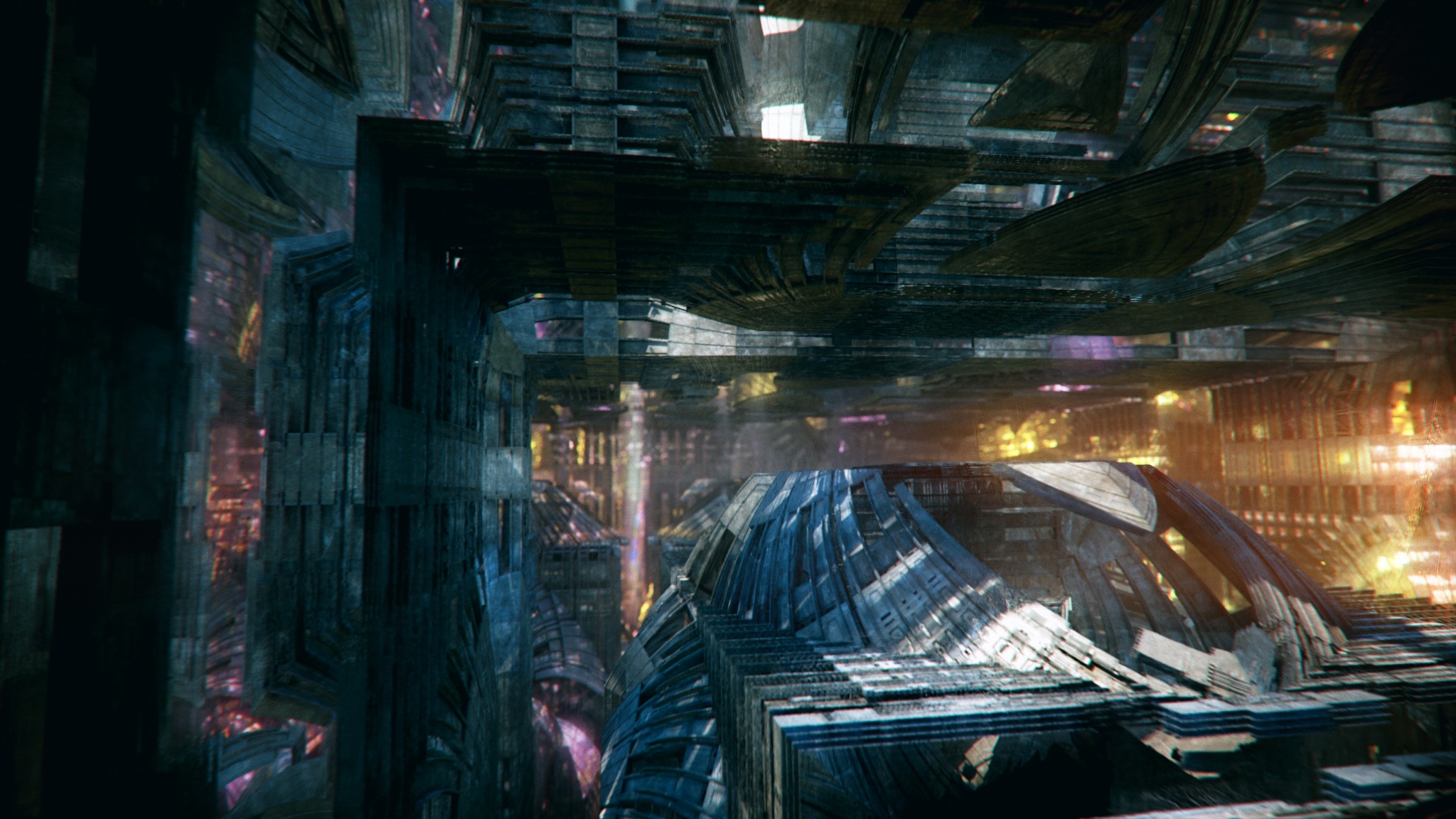
Generative urbanism.
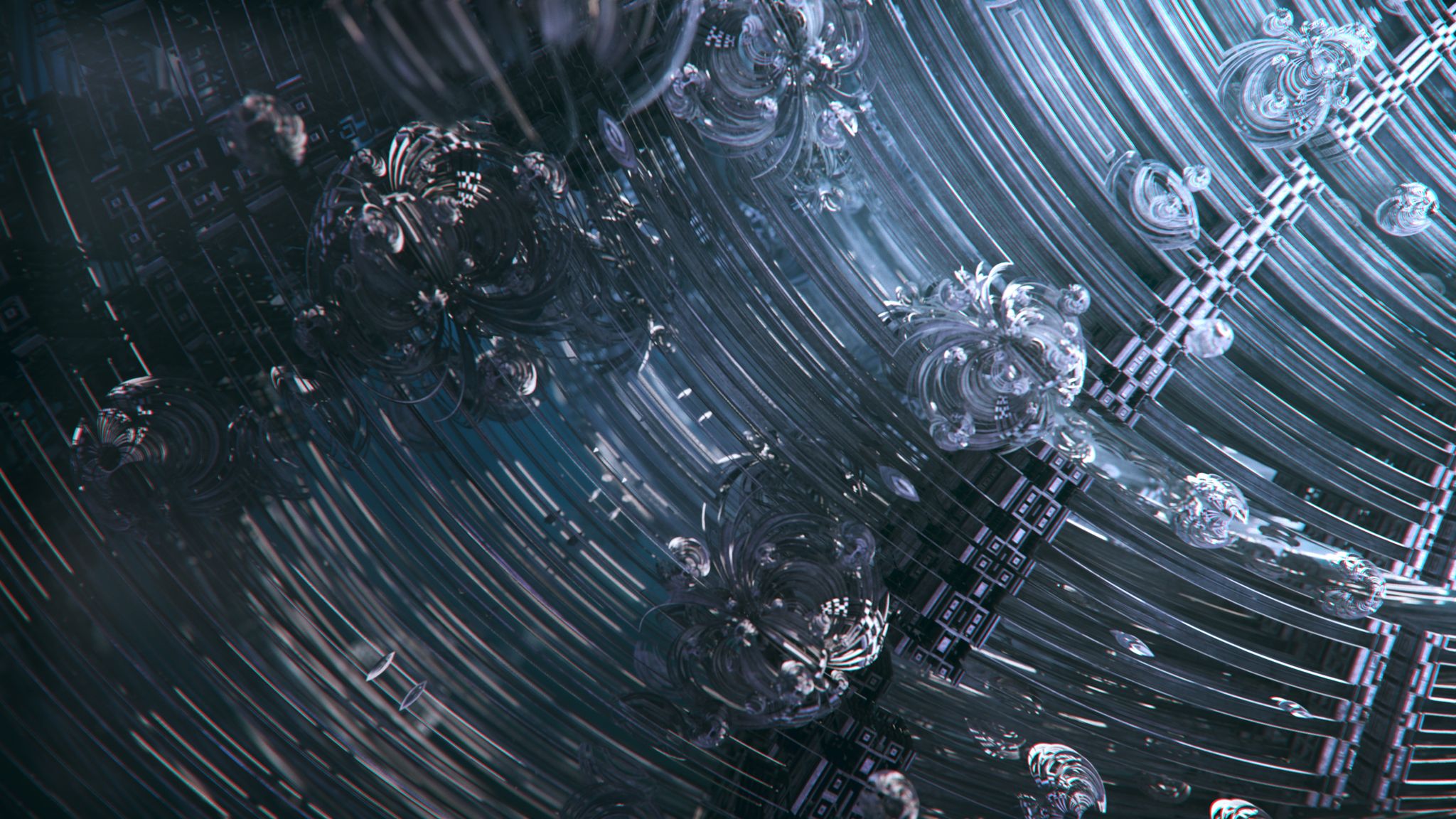
Emergent architecture.